Ephesus, a major seaport on the eastern Mediterranean and the capital of a Roman province in Asia, was a vibrant hub of commerce, and a center of Roman rule and the Roman imperial cult.
Centuries before becoming a political capital, Ephesus was a center of religious activity. Communities of Jesus-followers living in the Greek city of Ephesus at the end of the first century AD would be confronted daily with political and cultic imagery. The city was renowned for its devotion to various gods and goddesses.

Artemis
Christians in that Greco-Roman setting would be well aware of one of the most prominent goddesses: Artemis. Her temple was famous for its great size and for the magnificent works of art that adorned it (See video below.)
The Greek goddess Artemis was worshipped as the goddess of hunting, wild animals, and fertility. Her Roman counterpart was Diana. Goddess Diana shared similar aspects of deity with Artemis. She was worshipped as a benefactress of the countryside and nature, hunters, wildlife, childbirth, crossroads, the night, and the Moon (See video below.)
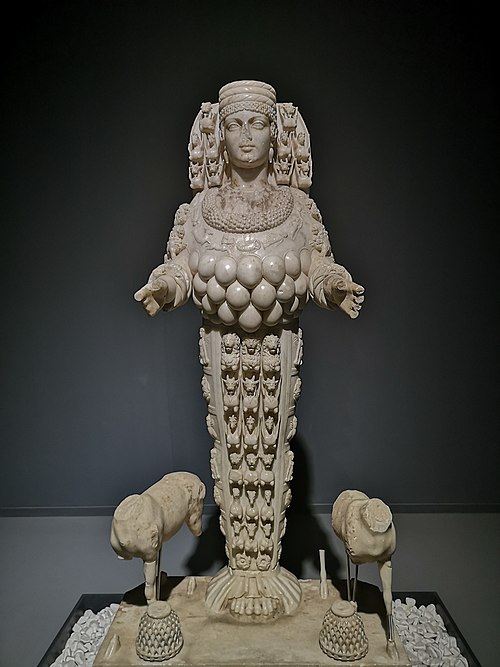
During his second missionary journey to Ephesus, the Apostle Paul caused a big stir with the Artemis image industry (c. A.D. 52) (Acts 18:19).
“Around that time there was a major disturbance because of the Way. There was a silversmith called Demetrius who made silver statues of Artemis, which brought the workmen a tidy income. He got them all together, along with other workers in the same business.
“Gentlemen,” he began. “You know that the reason we are doing rather well for ourselves is quite simply this business of ours. And now you see, and hear, that this fellow Paul is going around not only Ephesus but pretty well the whole of Asia, persuading the masses to change their way of life, telling them that gods made with hands are not gods after all! This not only threatens to bring our business into disrepute, but it looks as if it might make people disregard the temple of the great goddess Artemis. Then she – and, after all, the whole of Asia, indeed the whole world worships her! – she might lose her great majesty.” (Acts 19:23-28)

The temple of Artemis was one of the wonders of the world. Its great size and lavish decorations were a major attraction for the many pilgrims and tourists who came to Ephesus. Their Artemis image purchases provided the guild of silversmiths the coin to produce more images and to sustain their livelihoods. After listening to Demetrius, “the whole city was filled with uproar” and people shouted “Great is Ephesian Artemis!”
We read in Acts 19 that the town clerk quieted the crowd. A riot would bring the Roman army down on them. He said, “Citizens of Ephesus, who is there who does not know that the city of the Ephesians is the temple keeper of the great Artemis and of the statue that fell from heaven?”
Nike
Jesus-followers living in Ephesus would also be conscious of ubiquitous images of Nike, a Greek goddess who personified Victory. That Muse website has more about Nike:
“. . .she was almost always represented in Greek art as a beautiful, winged woman. Her main role in life was to fly around battlefields, rewarding victors. The winning soldiers received a wreath of laurel leaves, symbolizing fame and glory. But she also visited and crowned outstanding athletes and heroes.”
In Roman mythology Nike is called Victoria. She is depicted as holding a palm leaf with her right hand while carrying a laurel wreath on the other. She was worshipped by the Roman army as personifying speed, strength, and victory.
Polytheism
The citizens of cosmopolitan Ephesus were polytheistic. It was common for them to add new gods to their personal pantheon. Like with Artemis (Diana) and Nike (Victoria), different gods had different roles.
Polytheism was not a religion with written scriptures. People knew the multiplicity of Greco-Roman deities by their images and myths – their form of theology. Seeing their gods was a way to believe and to practice their contractual religion (do ut des, “I give that you might give”). Offerings and sacrifices were offered to the gods in return for certain favors.
Contrary to the explicit polytheism all around them – pagan temples, pagan priests, pagan priestesses, pagan worshippers and pagan idols – Christians, along with the Jews, were monotheistic. Ephesians tolerated Christians who worshipped a new and different god (except as noted above with Paul) as there were many gods divided up among many peoples. And it seems, at that time, that the Roman government did not yet have a policy of persecution of the Christians; official action was based on the need to maintain good order, not on religious hostility.
Political and Cultic Imagery
Citizens of this capital of the Roman Empire in Asia Minor would also celebrate and worship deified Emperors who claimed being a divine son of god. Julius Caesar, Augustus, Tiberius, and subsequent Roman emperors were regularly referred to as “son of god” (divi filius). Coins were struck with the imperial image on one side and “son of god” on the other.

The Roman Empire under an emperor claiming divine authority on earth, spread its political influence in religious terms using monuments, iconography, myths, and Imperial cult rituals.
Symbolizing victory, Victoria’s (nike’s) image was vital to the Roman military. Her likeness, with crowns, laurel wreaths, or palm branches as victory emblems, was seen on coins, sculptures, and architectural reliefs, triumphal arches, and monuments.

Worship of Victoria was also thought to bring good fortune and help with politics, business, and personal undertakings.
The goddess Artemis had been worshiped for centuries. Her great temple in Ephesus (one of the seven wonders of the world) and the cult of Ephesian Artemis was vitally important to the citizens, as notes N.L. Gill in his post The Cult Statue of Artemis of Ephesus:
“The Ephesians’ goddess was their protector, a goddess of the polis (‘political’), and more. The Ephesians’ history and fate were intertwined with hers, so they raised the funds needed to rebuild their temple and replace their statue of the Ephesian Artemis.”
The Dispatch
Into this political and cultic context at the end of the first century AD, a circular letter was sent around to Jesus-follower communities in and around Ephesus.
1 John is a pastoral letter that presents a no-nonsense counter-cultural narrative. It is full of contrasts: those born of the world and those born of the father, light vs. darkness, truth vs. falsehood, righteousness vs. sin, love of the Father vs. love of the world, and the Spirit of God vs. the spirit of the Antichrist.
The letter was penned by an eyewitness of gospel events and one who had seen way beyond the images and idols and imperial power of Rome. 1 John is a rebuke to the claims of the Antimessiahs and to the appeal of a pagan culture. It also provided spiritual reinforcement for the letter’s recipients.
1 John was most likely written by John the Elder (and not John the son of Zebedee and one of the Twelve; more below) around 90 AD during the reign of Domitian (81-96 A.D.). (Domitian believed in the divine nature of his rule, aligning himself with the lineage of the first Roman emperor Augustus. He saw himself as an absolute ruler and took pride in being called master or god: “dominus et deus.”)
John opens his letter, not with the typical (“grace and peace”) greeting, but with an authoritative “we” reassurance of his and other’s experience of Jesus, the son of God. He speaks in terms of visual, aural, and physical contact with the Messiah. This is crucial for what he writes against the “Antimessiahs”.
“That which was from the beginning, which we have heard, which we have seen with our eyes, which we have gazed at, and our hands have handled – concerning the Word of Life!” That life was displayed, and we have seen it, and bear witness, and we announce to you the life of God’s coming age, which was with the father and was displayed to us. That which we have seen and heard we announce to you too, so that you also may have fellowship with us. And our fellowship is with the father, and with his son Jesus the Messiah. We are writing these things so that our joy may be complete.” (1 John 1: 1-4)
John the Elder closes the circle of the fellowship of the joy bound by linking those (“we”) who were physically present with the Messiah with the Ephesian Christians who heard the gospel message and believed that Jesus is the Messiah, so that “our joy may be complete.”
(NB: The “joy” talked about here is not the DNC slogan “Joy”– a cover for the Harris cackle. Rather, John’s “our joy” completed would be the satisfaction of a deep yearning by the “we” for the readers to believe that Jesus is the son of God and the Messiah and for them to be included in the dancing embrace of the father, son and spirit.)
John then writes in terms of the associative “we” about what it means for followers of Jesus to have fellowship with him: we are not to deceive ourselves about our sin, we keep the Lord’s commandments and we show rightly ordered love. (1 John 1: 6 – 2:11).
Conflict Within and Without
The letter’s opening brings to the fore one of the main purposes of the letter: to reaffirm that Jesus, the son of God and the Christ, (mentioned some 24 times in the letter) did have a real body and not, as some were saying, that Jesus only seemed to be human, and that his human form was an illusion (Docetism). This thinking had come into Ephesian churches.
Stephen Bedard writes at the History of Christianity:
“Docetism was a doctrine in the early years of the Christian church that claimed that Jesus didn’t have a physical body. The name comes from the Greek dókēsis which means “to seem.” It refers to the belief that Jesus only seemed to have a physical body.
“It was understood that mind/spirit was good and body was bad. Since Jesus is good, he must be all spirit and not body at all. In modern language, Jesus was almost a hologram. He looked perfectly human but underneath the image, there was no muscle or bone.”
Those worshipping images would not believe that a god would come down and dwell in the flesh. They believed the gods stayed up and away from humans and did their own thing. Intellectual sorts, who were anti-incarnation, unethical, and loveless Gnostics, were deceiving Ephesian Christians (1 John 2:26).
John presented truth tests to discern whether they were false teachers. Anyone who denied that Jesus is the Messiah was not from God (1 John 4:2-3). They were a “liar” and an “Antimessiah” (1 John 2:22).
He writes about “the spirit of truth” and the spirit of error (1 John 4:6). And, that “many false prophets have gone out into the world” (1 John 4:1). “They went out from among us, but they were not really of our number” (1 John 2:19)
Denying that Jesus was the Messiah, the Antimessiahs split off from the church community. They didn’t accept Scripture’s references about Jesus or the testimony of eyewitnesses. (They were revisionist historians who, like many in Progressive churches today, homed in on his sayings. They think of Jesus in terms of being a fellow traveler who imparted esoteric truths.) Whatever love or joy the Antimessiahs had went with them when they left the church.
In his second letter, John echoes this warning: “Many deceivers, you see, have gone out into the world. These are people who do not admit that Jesus is the Messiah has come in the flesh. Such a person is the Deceiver – the Antimessiah!” (2 John 2:7)
(Ongoing conflict: Earlier (c. A.D. 52), Priscilla and Aquila, who had come to Ephesus with Paul, instructed a Jew named Apollos in the way of the Lord. Apollos then “vigorously refuted his Jewish opponents in public debate, proving from the Scriptures that Jesus was the Messiah. (Acts 18:28))
Beside the conflict within the local churches, there was the ever-present Roman Empire that expected worship of the emperor. John writing over and over that Jesus is the son of God (and not the emperor) put Christians in direct opposition to Rome. But it seems that, at that time, Rome was somewhat lax about forcing the Jews and Christians to burn incense for the emperor. If these two groups did disturb Rome’s Pax Romana, they would be dealt with.
(Calling Jesus “Lord” and having a “kingdom of God” message also conflicted with the Roman empire’s ‘divine’ prerogatives.)
Living as a Conquering Contradiction
As mentioned above, imperial Rome spread political propaganda through religion. And throughout Ephesus there would be visual representations of Roman conquest and power: grand architecture and monuments, centurions and soldiers all around, and the conquering, overcoming, prevailing, subduing, obtaining victory, Nike/Victoria images around the city and on coins.
Perhaps, with all of these images in mind, John the Elder writes:
“. . . everything fathered by God conquers the world. This is the victory (nike, νίκη) that conquers the world: our faith. (1 John 5:4):
Conquering Attitude
We, the “fathered by God” no longer continue sinning (1 John 3: 9; 5:18).
Because we are “fathered by God” we understand that we are God’s children (1 John 3: 1) and that loving one another is a character trait of all who know the father (1 John 4:7).
And because we are “fathered by God” and “God is love” (1 John 4:7-12), we as his children need not live in fear like the pagans who look to capricious gods and superstitious practices and the Roman state for understanding and favor. (Sounds like Progressives today.)
We understand that “the one in you is greater than the one who is in the world” (the Antimessiah) (1 John 4:4).
We believe that Jesus the Messiah has been fathered by God (1 John 5: 1), (The center of Christianity is the Incarnation of Jesus, God becoming flesh and dwelling among humanity. John railed against the Antimessiahs because he and others had witnessed the flesh and blood presence and power of the true Messiah. Jesus wasn’t some esoteric figure floating in the air. He wasn’t a statue or icon of a god. Jesus, son of God, Messiah, was “displayed” to John and others as a new way of being human.)
We understand that “we are from God, and the whole world is under the power of the evil one” (1 John 5:19). (As Paul wrote to the Ephesian church some 30-40 years before:
“For our struggle is not against flesh and blood, but against the rulers, against the authorities, against the powers of this dark world and against the spiritual forces of evil in the heavenly realms.” – Ephesians 6:12)
As the letter comes to a close, John reemphasizes his message:
“We know that the son of God has come and given us understanding so that we know the truth. And we are in the truth, in his son Jesus the Messiah. This is the true God; this is the life of the age to come. (1 John 5:20-21).
The letter of 1 John ends with a succinct pastoral exhortation based on what was said at the beginning of the letter positing, with full force, about the reality of what John and others had witnessed: “keep yourself from idols.”
Christians are not to get involved with unreality. They are not to collude with evil. Early Christians believed that idol worship in its various forms was used by demonic forces. The Apostle Paul in 1 Corinthians 10:21–22:
“You cannot drink the cup of the Lord and the cup of demons. You cannot partake of the table of the Lord and the table of demons. Or are we provoking the Lord to jealousy? Are we stronger than he?”
Those of us born of the father live in the tension of contrasts: light vs. dark, truth vs. falsehood, righteousness vs. sin, love of the Father vs. love of the world, and the Spirit of God vs. the spirit of the Antimessiahs. We are to overcome that tension with the reality of Jesus, son of God and Messiah.
I see tremendous forces (DEI, ESG, LGBTQ, Critical Race theory, WEF, WHO, Globalism, etc.) at work to conform everyone into a monolithic unity of enforced pluralism subject to one Satanic Beast. Those who confess loyalty to the Beast will find it easier to get a job, move up, gain tenure and more. Those who don’t will be called “weird” and sacrificed to the Beast.
In the milieu of this sociocultural pluralism, it would be quite easy to glide into a religious pluralism and end up worshipping the vaunted images of the world and rage against those who don’t – “Great is Ephesian Artemis!”
And, with the multiplicity of political and cultic images generated daily to influence behavior, it would be quite easy to glide into a religious pluralism so as to be accepted, to have “likes” and clicks and to avoid the pressure being applied by the culture. One would thus end up having a form of godliness (virtue signaling) but denying its power (2 Timothy 3:5). Neither John the Elder nor I want anything to do with such people.
For those who question the uniqueness or claims of Christian faith, John’s letter with truth tests would be in order.
No longer just image bearers of the One True God, we are more: overcoming image bearers of Jesus, the son of God, Messiah, and Lord.
~~~~
This circular pastoral letter was most likely written by John the Elder (and not John the son of Zebedee, one of the Twelve). John was from an aristocratic family in Jerusalem and a member of the High Priest’s family.
According to Polycrates, bishop of Ephesus late in the second century, John (the Elder), “who leaned back on the Lord’s breast,” was a (Jewish high) “priest” (who had officiated in the Jerusalem temple early in his life), a “witness”, and a “teacher” (Eusebius, Hist. Eccl. 5.24.2-7). (cf. Acts 4:6 & John 18:15, John’s record of Jesus’ high priestly intercessory prayer in John 17, and his courtyard access John 18:15).
John the Elder was most likely the Beloved disciple mentioned in John 21: 20-23. Because of his proximity to Jesus, John the Elder was an eyewitness of the events of gospel history. He was at Jesus’ crucifixion and given charge over Mary. He eventually brought her with him to Ephesus.
“When Jesus saw his mother there, and the disciple whom he loved standing nearby, he said to her, ‘Woman, here is your son,’ and to the disciple, ‘Here is your mother.’ From that time on, this disciple took her into his home.” (John 19:26-27)
John the Elder most likely wrote the Gospel of John and the three Johannine letters – 1, 2 & 3 John.
~~~~~
Temple of Artemis at Ephesus – Sanctuary of the Ephesian Diana (learning-history.com)
Greek Mythology Explained | Artemis: Goddess of the Hunt | Miscellaneous Myths (youtube.com)
~~~~~
Within days, global elitists will try to put world government on steroids. The perpetrators don’t want us to know it, but that’s the purpose of the upcoming “Summit of the Future” and the accord it is supposed to adopt, dubbed the “Pact for the Future.”
Rather than openly doing so by voting to revise the United Nations Charter, the idea is to launch a “process” to be conducted largely behind closed doors. The UN’s Secretary-General and former president of the Socialist International, Antonio Guterres, however, has let slip that process’ goal – namely, granting him authority unilaterally to declare and dictate the responses to emergencies caused by any of a number of so-called “complex global shocks.”
Read the UN document here>>>> “Pact for the Future” – The Socialist Manifesto (malone.news)
Contact your representatives!!
Take action here>>> THE U.N. IS NOT A WORLD GOVERNMENT – KEEP IT THAT WAY! | AlignAct
9-11-2024:
Globalist Ambitions at the U.N.’s Summit of the Future (rumble.com)
BRIEFING: Globalist Ambitions at the U.N.’s Summit of the Future – Sovereignty Coalition

~~~~~
My sister sent me this video. I agree with Hamrick:
Church, Unite for the Soul of America! | Ezekiel 33:1-5 | Gary Hamrick (youtube.com)
I get the sense that there are Christians who want to hurry off to heaven. They believe that there will be a rapture and they will be taken away from the trouble on earth and therefore voting doesn’t matter. Understand, there will be NO rapture. That is a misinterpretation of Scripture. Go vote!!
~~~~~
Nicole Shanahan on X: “Who really are the MAGA People? https://t.co/Zk6rvijCge” / X
~~~~~~
In late August officials [of China’s Communist Party] published regulations for dealing with them [the corrupt, criminal and disloyal], too. The aim is to reform or expel people who show a “lack of revolutionary spirit” . . .
Religious members are seen as another problem. Newbies must swear that they are atheist. But many still harbour beliefs in the supernatural. . . According to the regulations, religious folk should be given a chance to renounce their beliefs—and kicked out if they do not.
How to get kicked out of China’s Communist Party (archive.is)
~~~~~
Contentious Culture Wars in a Polarized Political Age: A Conversation with Sociologist James Davison Hunter
~~~~~
[i] Bauckham, R. (1993/2018). The theology of the Book of Revelation. PP 88-89
https://doi.org/10.1017/cbo9780511819858

 Kingdom Venturers