April 1961. The first human to travel into space returned to Earth after traveling 17,500 mph for 108 minutes. He circled the earth once at a maximum altitude of 203 miles.
About 4.35 miles above the Earth, Russian cosmonaut Yuri Gagarin ejected from Vostok 1, a pressurized spherical capsule just two meters wide. He parachuted to the ground.
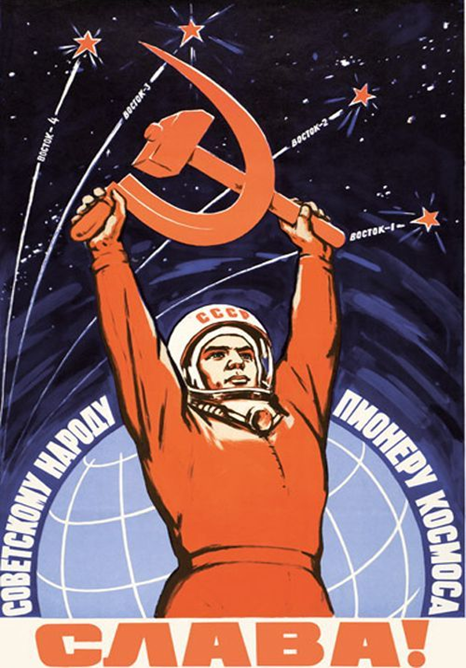
This first of its kind scientific event made Gagarin a space hero and made for a compelling narrative for the Soviet system to promote socialism and scientific atheism:
“For Soviet Communism, cosmonauts were utopianism made flesh – Socialist Realist heroes come to life – and Socialist Realism and socialist reality were never closer than during the Soviet space age.” [i]
After Joseph Stalin died on March 5, 1953, Soviet leaders during the Khrushchev era (1953-1964) were eager for a return to party purity. Stalin had given up trying to purge religion from Soviet Russia. He had wanted to produce an atheist society. But after seeing that the stubborn religiosity of the masses could not be eradicated, he finally decided to maintain authoritarian control over it. He heavily regulated churches and church leaders to keep them politically impotent.
“Under Khrushchev, then, the party realized that it was not enough to eliminate the political and economic base of religion. In order to transform the Soviet society of the present into the Communist society of the future, religion had to be eradicated not just from Soviet politics and public life but also from Soviet people’s consciousness.”[ii]
Khrushchev’s focus on party purity meant a return to campaigns to eradicate religious “survivals” and the promotion of a scientific materialist conception of the world as outlined by Marx-Leninism. The latter, in the form of secularist rituals, was supposed to fill the void left behind by a life without religion.
Soviet space flights were thought to show the world that the Soviet’s scientific, materialist, and atheistic worldview was superior to that of the religious and capitalist U.S. After all, wasn’t science the only path to knowledge, and matter the fundamental reality? And wasn’t it reason and not God who put a man into space? And a space-hero cosmonaut who didn’t see God in space, well . . .
Before a plenary session of the Central Committee, Russian Premiere Nikita Khrushchev gave all the Party and Komsomol organizations [Young Communists] the mission of promoting anti-religious propaganda. With that directive he said: “Why are you clinging to God? Here Gagarin flew into space and didn’t see God.”
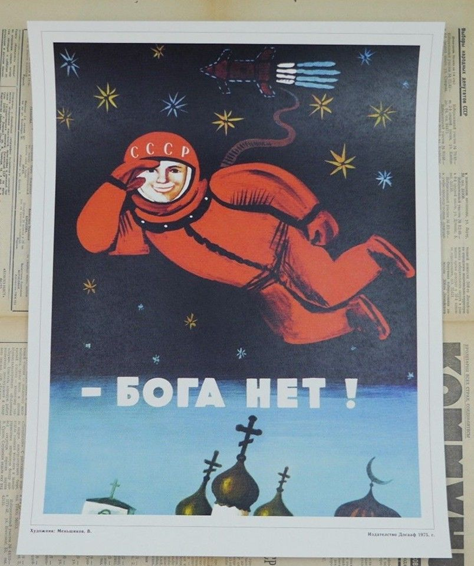
Yuri Gagarin’s close friend and colleague, Colonel Valentin Petrov, denied that Gagarin ever said that. The words put in Gagarin’s mouth by Russian Premiere Nikita Khrushchev and Gagarin’s supposed godlessness became popular folklore and a party narrative created to support atheism. The party knew that people would have believed more in Gagarin’s words than in Khrushchev’s.
From out of the heavens, Yuri Gagarin, a baptized member of the Russian Orthodox Church, reentered into a world system that set itself up opposed to God. Gagarin was made a caricature of the atheistic propaganda the party wanted to propagate.
Khrushchev: “Why should you clutch at God” (you cannot see when you look out the capsule window into space when you can envision a materialist utopia in the successful figure of our own cosmonaut Yuri Gagarin.)
~~~~~
A view through a window into heaven . . .
At the end of the first century CE, seven churches of Asia received a circular letter sent from the island of Patmos. The author composed the letter “in the spirit” on the Lord’s Day. The letter was to be read out loud in full on the Lord’s Day when Christians met for corporate worship. Their circumstances served as a type of inset in the letter’s cosmic space-time mapping.

The churches were situated in a Roman province in what is now western Turkey. Some twenty years before, the Roman Empire unleashed its full power against a Jewish rebellion resulting in the fall of Jerusalem and the complete destruction of the Second Temple.
Though Christian persecution had been sporadic, the oppressive nature of the Roman Empire made for distressful times for these early Christians. Devotion to and worship of only one Lord and God kept these Christians under suspicion by Roman authorities.
The surrounding Greco-Roman culture was polytheistic. The official state religion, headed by Jupiter, was the Roman pantheon of gods. Temples to Jupiter, Mars, and Venus were built throughout Rome. Being able to add your god or goddess to the local pantheon of gods worked to keep a diversity of religions in check for Pax Romana.
The Roman empire operated under ‘divine’ authority. The emperor, both a political and a deified religious figure, held absolute power. He maintained authority through political alliances, military might and a dutiful citizenry.
Public support for the imperial cult worked to solidify the emperor’s authority. Citizens were expected to show loyalty to the ‘divine’ emperor by participating in religious festivals, rituals, and emperor worship. Neglecting the imperial cult was considered treasonous.
Throughout the empire Roman power and political influence were on display with monuments, mosaics, iconography, frescos, and image-stamped coins. Adding to perceptions of Rome as a formidable world power was literature, inscriptions, myths, architecture, and elaborate public ceremonials.
All eyes on the emperor.
Roman imperial propaganda was also used to shape the public’s perception of the emperor. His presence, like Rome’s, was to be sensed everywhere – in public places and in the sanctuaries of the imperial cult in provincial towns.
Emperors were depicted as tough warrior and general types and as benevolent paternalistic protector and statesman types. At the time of the Patmos letter Emperor Domitian governed (81 to 96 CE) as divine monarch and benevolent despot. As such, he saw himself as a cultural and moral authority able to guide every aspect of a citizen’s life.
The expectation for everyone under Roman rule was to respond to Rome in its terms and beyond that, to show devotion to the sovereign emperor. Or, feel the force of the empire. Fear was the motivation. “Bread and circus games” were the distractions used to deflect from the fact that Roman emperors were selfish and incompetent tyrants.
The Patmos letter was sent to those who held an expectation of God’s coming universal rule and to those who lost that focus. A clash between an all-powerful Sovereign and his kingdom and the ubiquitous domineering emperor and empire was expected. The letter, with vivid prophetic imagery, did not disappoint.
Every eye will see him.
Christians in the seven churches, upon hearing “Look! He is coming with the clouds, and every eye shall see him, yes, even those who pierced him. All the tribes of the earth shall mourn because of him. Yes! Amen,” looked out the window of their imagination to see Christ and the coming of God’s universal rule.
As the letter was read, they recognized the “satanic trinity” fighting against them and God’s kingdom on earth: “the dragon or serpent (the primeval, supernatural source of all opposition to God), the beast or sea-monster (the imperial power of Rome), and the second beast or earth-monster (the propaganda machine of the imperial cult).”[iii]
And they heard a devastating critique of Roman power dynamics. The letter recognized “the way a dominant culture, with its images and ideals, constructs the world for us, so that we perceive and respond to the world in its terms. Moreover, it unmasks this dominant construction of the world as an ideology of the powerful which serves to maintain their power.”[iv]
They also envisioned their role in saying “No” to the idolatries of Rome (Babylon) and to be a witness of the truth worth dying for to all tribes of the earth. And then the Day of the Lord.
After hearing the letter read, the church community once again reentered into a world system opposed to their Sovereign. But now they had something their imaginations could clutch – a view of God’s throne room and of “what must soon take place” – and a counter-cultural approach for the church.
More about John’s Apocalypse or The Revelation of John in the next post.
[i] Smolkin, Victoria. A Sacred Space Is Never Empty: A History of Soviet Atheism. Princeton University Press, 2018. https://doi.org/10.2307/j.ctt1zgb089. PP 86-87
[ii] Ibid 61
[iii] Bauckham, Richard. (1993/2018). The Theology of the Book of Revelation. Cambridge University Press, 1993. https://doi.org/10.1017/cbo9780511819858. PP 89
[iii] Ibid 159
~~~~~
A counter-cultural approach for the church
In this parable of Jesus, recorded in the gospel of Mark (chap. 4), notice how the kingdom of God grows – not by power, might or militancy:
“This is what God’s kingdom is like. Once upon a time a man sowed seed on the ground. Every night he went to bed; every day he got up; and the seed sprouted and grew without him knowing how it did it. The ground produces crops by itself: first the stalk, then the ear, then the complete corn in the ear. But when the crop is ready, in goes the sickle at once, because harvest has arrived.”
~~~~~
Melanie Hempe, founder of Screen Strong, joins host Scot Bertram of Hillsdale College to discuss how to prevent your children from forming a lifelong screen addiction, simple tips for reducing screen time, and how to answer questions from other parents.
How to Combat Screen Addiction – Hillsdale College Podcast Network

~~~~~

 Kingdom Venturers