A 7th century BCE proverb, attributed to Greek poet Archilochus, speaks of two ways of perceiving the world:

“The fox knows many truths, but the hedgehog knows one big thing.”
The fragment on which this metaphor was found doesn’t include what the poet meant or to whom he was referring to. But amplified versions of the two contrasting ways of thinking have come along.
Basically, hedgehog types, it is said, ignore many things available to them and relate everything to a single organizing idea – one big thing – that guides how they understand, think, and feel.
Fox types, on the other hand, take in the big picture. They pursue many ends and draw upon many experiences and perspectives, some of which may be self-contradictory. They are pluralistic and know many things and approach issues from diverse perspectives.
In his 1953 essay “The Hedgehog and the Fox,” Sir Isaiah Berlin (1909-1997), a Russian-British social and political theorist, philosopher, and historian of ideas explored these two different approaches to perceiving reality – diversity or unity in thought; breadth or depth in intellectual pursuit.
Berlin saw hedgehog types as possessing a singular, unifying vision that guides their understanding of the world. To get to an essential monistic worldview, hedgehog thinkers simplify the complex and may even accept easy explanations. They hold strict beliefs and are not likely to consider alternatives. As such, they are idealists who are not likely to waver from their purpose. They have a singular focus.
Berlin saw Fox types as being curious and wanting to explore, as knowing many things. They draw upon diversity and complexity. With new perspectives, they adapt. They are practical and not ideological. Foxes see the world in all its intricacy and interconnectedness.
Robert McCrum, writing in The Guardian about Berlin’s essay: “the division of humanity into hedgehogs and foxes had become not only a witty means of classification, but also an existential way of confronting reality. Foxes, for instance, will come to understand that they know many things, that a coherent worldview is probably beyond them and that they must be reconciled to the limits of what they know . . .
“Berlin’s hedgehog, by contrast, never makes peace with the world and remains unreconciled. His or her purpose is to know one thing and” quoting Isaiah Berlin’s biographer’s words, “strive without ceasing to give reality a unifying shape. Foxes settle for what they know and may live happy lives. Hedgehogs will not settle and their lives may not be happy.”
The subtitle of Berlin’s essay: An Essay on Tolstoy’s View of History. The Greek poet’s saying had Berlin seeking to classify Lev Tolstoy as a either a fox or a hedgehog based on Tolstoy’s philosophy of history as expressed in his novel War and Peace. Both War and Peace and Anna Karenina are written with an overarching moral order and with life’s intimate details. And, there are characters in each novel that exhibit the two different mindsets.
Asking whether Tolstoy’s “vision is of one or of many, whether he is of single substance or compounded of heterogenous elements,” Berlin decided, “there is no clear or immediate answer.” Berlin thought that Tolstoy embodied both the fox and the hedgehog types of thinking.
Berlin did categorize well-known thinkers and artists.
Those with profound central visions, were systematic and held rigid ideas about life he considered hedgehogs. He included Plato, Dante, Pascal, and Dostoevsky in this category.
Those who took in and thrived on a wide range of multi-layered experiences were the foxlike. He included pluralist thinkers Aristotle, Shakespeare, Goethe, and Joyce in that category.
~~~
The above is a brief summary of a school of thought that summarizes mindsets into two groups. You can read more about the Fox and Hedgehog Theory and how the two ways of thinking have been compared and how each mode is thought to apply at What is the fox and the hedgehog theory? where this table is found:
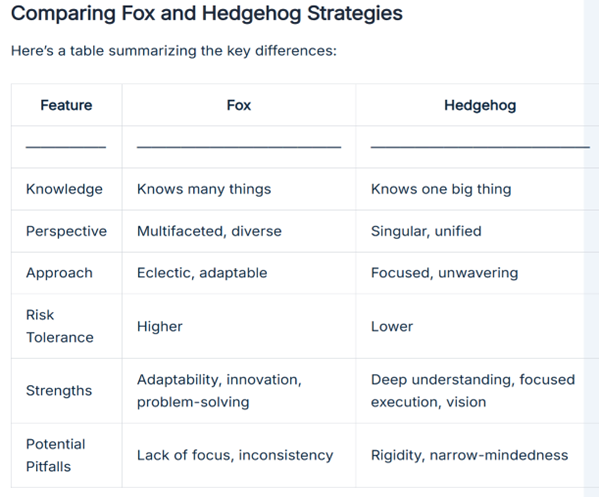
Using the supposed traits of each mindset, some have extrapolated how each mindset operates in terms of business and politics and in problem-solving and leadership skills.
Some may compare the two ways of thinking as a Fixed or Growth mindset.
Of course, Berlin’s interpretation is not supported by the Archilochus fragment. And there are those like myself who see the project as oversimplifying the multifaceted way we think and do so in diverse contexts.
Consider, for one example, the single-minded focus of a violinist who, in private, rehearses Paganini Caprice no. 5 and then at the time of performance, tunes her instrument to A440 and then plays focusing on the bowing and her performance.
Think of an orchestra conductor who sees the scoring of all the instruments and hears the sound of the whole ensemble. He directs the musician’s phrasing, tempo and sound according to his interpretation of what the composer had in mind.
Both solo violinist and conductor are focused on their “one big thing” and both are aware of the setting and the acoustics. They each listen to what comes forth and adapt as needed to enrich the performance for the listener.
Introduction to Berlin’s Division – Hedgehogs and Foxes
https://www.bookey.app/audiobook/hedgehog-%26-the-fox
~~~
Northwestern professor Gary Saul Morson refers to the fox and hedgehog saying and to Berlin’s essay in the conclusion of his magnum opus on classic Russian literature: Wonder Confronts Certainty: Russian Writers on the Timeless Questions and Why Their Answers Matter.
Throughout the book, Morson provides examples of how certainty and wonder played against each other in the writings during the Soviet era.
The nineteenth-century Russian intelligentsia and its Bolshevik successors embodied Certainty. The intelligentsia or “party-minded” related everything to a single central vision – a scientific-materialist-atheistic worldview – and did so with dogmatic certainty. Everything, everyone, and reality itself had to conform to the iron-grip of ideology. Violence made sure.
Russian realist prose, with questions posed, evoked Wonder. Realist authors drew upon the complexity in the world, its many human experiences and perspectives. They wrote about the world and the human condition in realist terms – as it was and not as it was end-of-history supposed. They knew life had contingencies and that there was no one single way to go about things
You can read more about this in my previous posts A Mind is a Terrible Thing to Hand Over and Reentry.
Implicit throughout Wonder Confronts Certainty is the contrast of the fox and hedgehog mindsets in Russian writers. Only in Conclusion: Into the World Symposium does professor Morson refer to the fox and hedgehog saying and to Berlin’s essay. He does so to make the point about “true dialog.” He writes:
Life is eternal dialogue, a world symposium that never ends. In Bakhtin’s notebooks we discover his core belief:
The dialogic nature of human consciousness. The dialogic nature of human life itself. The single adequate form for verbally expressing authentic human life is the open-ended dialogue. Life by its very nature is dialogic. To live means to participate in dialogue: to ask questions, to heed, to respond, to agree, and so forth. In this dialogue a person participates wholly and throughout his whole life: with his eyes, lips, hands, soul, spirit, and his whole body and deeds. He invests his entire life in discourse, and his discourse enters into the dialogic fabric of human life, into the world symposium.[i]
Further on, under the subheading The Fox Knows Many Things, Morson writes:
Given human difference and the plurality of viewpoints, wisdom consists in learning to see the world from the perspectives of others. By intellectual as well as emotional empathy, we can bring discrete positions into open ended-dialog. When we do, we enrich both ourselves and the world.[ii]
~~~
I don’t see a need to classify myself as a fox or hedgehog. There are benefits of both mindsets. I can hold two different things in my mind at the same time, and I am able to adapt to new situations.
I don’t have a degree in any area. As an autodidact, I have an open-ended humanities attitude toward life.
I am by nature a fox that takes in the big picture and I am also a hedgehog that focuses. I see the whole and wonder. I then drill down to explore my wonder. The game is afoot. A reader of my blog over time will notice this. I touch on various topics and often drill down to explore meaning. I do this so that I may understand what I think and to send it out in a post and have it come back to me as wisdom I can use.
I try to avoid binary, black or white, either/or, left-brain oriented thinking. It’s not easy in a polemic world. The “dialogic nature of human life,” if invested in, can make a person knowledgeable and wise. And so can Michael Polanyi’s concept of knowing: ‘from-to’ subsidiary-focal-integration. See the video below.
~~~~~
How Can We Know Anything? Artful Knowing with Esther Meek
Philosopher Esther Lightcap Meek explores everyday life, how our understanding of knowledge shapes everything, from faith to creativity to everyday life. Esther challenges the modernist assumption that knowledge is merely information gathering, arguing instead for a view of knowing that is personal, participatory, and artful.
“Polanyi will argue that apart from personal epistemology as he describes it, not even knowledge is possible, let alone realism. Positively, he will view realism as integral to personal knowledge and vice versa” Esther Lightcap Meek
Discussed:
How the “knowledge as information” paradigm cuts us off from reality
Michael Polanyi’s concept of subsidiary-focal integration
Why imagination is essential to all knowing (including science!)
The relationship between attention, love, and knowledge
How artful knowing can help us navigate crises of faith
The doctrine of creation and wonder in the ordinary
Re-enchantment vs. the “lively real”
Comparing Esther’s work with Iain McGilchrist’s brain hemisphere research
https://www.estherlightcapmeek.com/
~~~~~
Hedgehog Mindset?
Monologue – Death at the President’s Lodging by Michael Innes
We are clerks, medieval clerks leading this mental life that is natural and healthy only to men serving a transcendental idea. But have we that now? And what then does all this thinking, poring, analyzing, arguing become – what but so much agony of pent-up and thwarted action? The ceaseless driving of natural physiological energy into narrow channels of mentation and intellection… (p. 80)
Hedgehog TDS:
In a January 2026 media article in The New Criterion – A range of derangement: On the persistence of Trump hatred – James Bowman notes a Wall Street Journal article Is Trump Derangement Syndrome Real?
We now have it on the authority of a licensed psychotherapist that “Trump Derangement Syndrome” (tds) is clinically real—though it’s probably not destined to have its own entry in the Diagnostic and Statistical Manual of Mental Disorders of the American Psychiatric Association any time soon. Writing in The Wall Street Journal, Jonathan Alpert claims that he finds a mental illness worthy of the name in his Manhattan-based practice,
where the presentation aligns with anxiety and obsessive-compulsive disorders: persistent intrusive thoughts, emotional dysregulation and impaired functioning. Patients describe sleepless nights, compulsive news checking and physical agitation. Many confess they can’t stop thinking about Donald Trump even when they try. They interpret his every move as a threat to democracy and to their own safety and control. Call it “obsessive political preoccupation”—an obsessive-compulsive spectrum presentation in which a political figure becomes the focal point for intrusive thoughts, heightened arousal and compulsive monitoring. (Emphasis mine.)
Speaking of hedgehog TDS . . .
Responses to a squishy feminized elite:
Late Friday, New York Times columnist David French snarkily referred to Secretary of War Pete Hegseth as a “walking MAGA caricature” on X.
Four hours later, Hegseth’s troops were pounding Iran in an intricate series of strikes that left its evil regime reeling.
The response to French — who has not withdrawn his sneer — was unsympathetic.
My favorite: “Let’s have a contest . . . you and Pete show up at Fort Bragg, see who the troops respect more.”
Is Hegseth a caricature?
To French and his ilk, maybe; but to many others, he’s a guy who gets results.
Presumably a 1945 David French would have considered Gen. George S. Patton a caricature, too . . .
As commentator William Wolf observed on X, “The fact that a billionaire real estate playboy who liked to slap his name on steaks and wine has proven to be a better diplomat and military strategist than every other politician and foreign policy expert over the last 30 years is such a damning indictment of the DC establishment I honestly don’t know how they recover.” Emphasis mine.)
Glenn Harlan Reynolds is a professor of law at the University of Tennessee and founder of the InstaPundit.com blog.
Why Trump and Hegseth’s swagger leaves the ‘elite’ seething
Fox Mindset?
Time for climate education:
Dr. Willie Soon Reveals the Real Driver of Climate Change in New Video – PJ Media
~~~~~

[i] Morson, Gary Saul. “Conclusion: Into the World Symposium.” In Wonder Confronts Certainty: Russian Writers on the Timeless Questions and Why Their Answers Matter, 384. Harvard University Press, 2023. https://doi.org/10.2307/jj.1791936.16.
[ii] Morson, Gary Saul. “Conclusion: Into the World Symposium.” In Wonder Confronts Certainty: Russian Writers on the Timeless Questions and Why Their Answers Matter, 388. Harvard University Press, 2023. https://doi.org/10.2307/jj.1791936.16.

