In trying to understand the phenomena of the double down defiant, the disruptive and destructive characters under the evil enchantment of our culture, I came across the vain imaginings of main character syndrome (MCS).
Seeing yourself as the main character in a narrative of one’s own struggles, a mediated aspect of MCS, is considered normal. You might hear a life coach say: “Living your hero life starts in your head—and it’s won in your daily choices.” Our culture embraces the internalized hero narrative.
Scientific American says To Lead a Meaningful Life, Become Your Own Hero
Forbes offers How To Become The Hero Of Your Story: Eight Steps
But when someone believes that their experiences and problems are more important than the next guy’s experiences and problems, that self-serving perspective is nobody’s friend.
And when someone starts acting like they’re the main character of not only their story, but everyone else’s, that is delusional and narcissistic. Imagination and passions take on a dramatic self-narrative that entails self-absorbed behavior, a lack of empathy, and seeing everyone else as a side character.
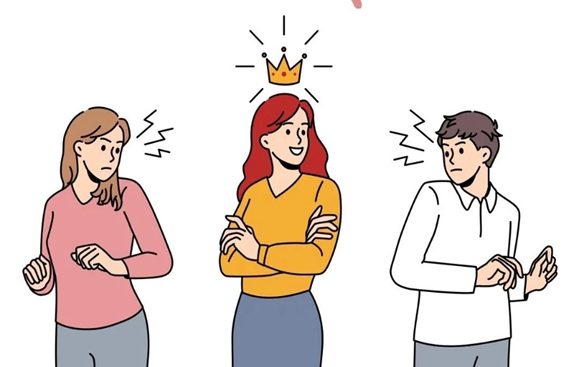
Taking on this perverse aspect of MCS, a person views their life as a movie and themselves as the central character. Such a person romanticizes their importance on the world stage. They behave as if they always have an audience. Checking in with others to invoke reality-based self-reflection is not a consideration. Basking in the mind’s spotlight is more important.
When I first came across main character syndrome, I immediately thought of Anna Karenina in Tolstoy’s novel by the same name. Some have suggested that Anna is the heroine of the novel. Oprah called the novel “one of the greatest love stories of our time” referring in particular to the passionate and illicit love affair of Anna and Count Vronsky in a milieu of 19th-century Russian social norms.
But the heroines of “one of the greatest love stories of our time” are two women whose prosaic love pays attention to those around them. Dolly is not caught up in romantic notions of herself or life. She is down-to-earth practical with her love. And, it is Kitty’s self-giving love shown to her husband’s dying brother that the analytical Levin comes to recognize as making the world go round.
Anna is all drama, all self-absorbed, all self-deception, all main character syndrome. Everyone else is a side character.
It should surprise no one that a person with MCS may also have narcissistic personality disorder (NPD).
Someone with NPD is characterized with a perverse self-interest, grandiosity, entitlement, and power fantasies. Such are manipulative, emotionally immature, attention-seeking, and lacking empathy.
In practice, such a person may focus on information patterns in the MSM and social media and ignore anything contradictory. This myopic view of things provides a confirmation bias for an imagined reckless hero narrative.
Did Renee Good and Alex Pretti hone in on the anti-ICE media narrative that included the tough guy talk of Democrat politicians – Minnesota’s governor Tim Walz, AG Keith Ellison, and Minneapolis Mayor Jacob Frey – and then hone in on ICE officers? Did the rash Good and Pretti act out their ‘confirmed’ narrative?
Does MCS have a cultural imprimatur?
James Bowman wrote about the Tough Talk of the above politicians and the street theater response “their intemperate language” could be expected to invoke. He went on to reference Kat Rosenfield’s The Free Press article Minneapolis Isn’t a Movie which carries the subheading “There is a pervasive sense that ICE agents are more like cartoon villains than legitimate law enforcement. The killing of Renee Nicole Good proved this a dangerous illusion” and then referenced a Substack article:
After Alex Pretti was killed, Michael Shellenberger wrote on his Substack,
Both Good and Pretti were thirty-seven years old when they died, and Millennials, more than Gen X before and Gen Z after, are very progressive and are “heroes in their narratives,” researchers find. The deaths of Good and Pretti are thus the result of a collision of forces that have been building for decades. After World War II, fighting Nazis and fascists became the number one heroic fantasy for Americans and others in the West. And Baby Boomers taught their own revolutionary heroic values to their Millennial children, who see fighting Trump and ice as an opportunity to achieve a form of transcendence.
Do the endless world-saving super hero movies and video games contribute to MCS? What about viewing everything in terms of power dynamics and a hero-villain victim-oppressor narrative? Wouldn’t an action-hero of such fantasies want to bash an oppressor with her car?

Validation of a self-serving bias is accomplished when media comes along to chronicle the deadly street theater in heroic terms and to direct blame away from the deadly aggressor and place it on ICE and Trump and anything else except the character who acted out their hero fantasy.
Such validation will have the “heroes in their narratives” double down their acting out. (The deep state loves those with MCS. The deep state doesn’t care how many are lost to protect itself.)
Our culture has produced and enabled many “heroes in their narratives”, including alleged assassins and alleged attempted assassins.
Luigi Nicholas Mangione is accused of murdering of Brian Thompson, CEO of UnitedHealthcare.
Tyler James Robinson is accused of murdering Charlie Kirk.
20-year-old Michael Steven Sandford attempted to steal a police officer’s firearm and use it on Trump, during a rally in Las Vegas, Nevada.
Gregory Lee Leingang stole a forklift from a North Dakota oil refinery and later confessed to trying to kill the then-president by flipping the vehicle.
Thomas Matthew Crooks opened fire at a rally in Butler, Pennsylvania.
Ryan Wesley Routh broke into Trump International Golf Club and staked out for several hours before Trump.
Those with attention-seeking main character syndrome include left-leaning cosplayer Christians (James Talarico, David Brooks, and David French to name a few ), politicians (Gavin Newsome, J.B. Pritzker, Tim Walz, Barack Obama, and Jasmine Crockett to name a few) and federal and supreme court justices who want to be seen as heroes resisting the Trump administration. These and more are promoted on MS-13 (MS NOW), the NYT, and other propaganda outlets.
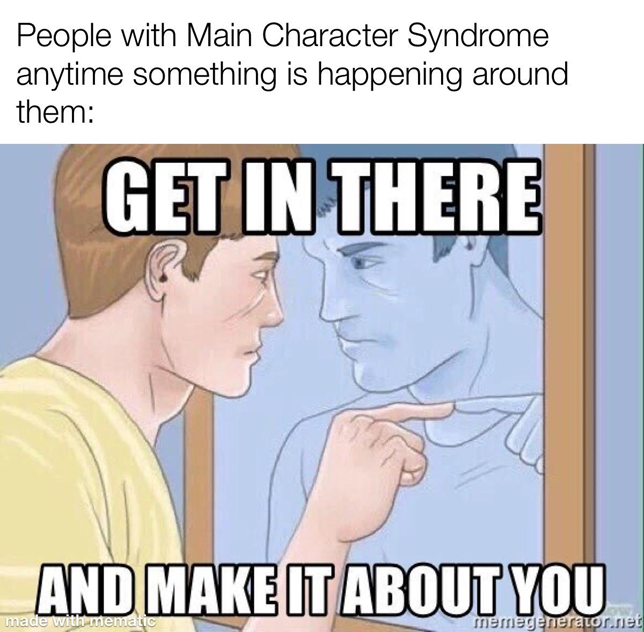
Those with attention-seeking main character syndrome include a host of activists who want the world to be looking at them as they do battle against media-designated oppressors. Hence the ubiquitous presence of cameras to record themselves on social media.
Islamism produces main character syndrome that generates “Allahu Akbar” terrorism characterized by a lack of empathy for anyone not embracing Islam and ‘heroically’ responding to Qur’an’s call to Muslims to “strike terror in the enemies of Allah” (8:60).
For those with main character syndrome, what occurs is not a lack of feeling, but a lack of understanding. Hindsight, foresight and insight are banished for the sake of a romanticized fantasy that places them at its center.
Read about Pseudo-heroes here:
With hedgehog mindsets, those with main character syndrome have taught themselves not to see anything but themselves in the drama they concoct, a drama that is validated by the confirmation bias of the media and mullahs. Self-deception is key to MCS and the media and mullahs enable self-deception.
~~~
Identity Shaped by the Misshaped
I don’t find it surprising that main character syndrome is a thing when modern culture works to remake identity with its evil enchantment and the loss of a tangible community to help us break that spell.
A mechanized worldview banishes all transcendence in its path and would have us believe that the source of meaning comes from within the world of ourselves. Such a disenchanted perspective of the goodness of the Good can foster the utmost ruthlessness and egoist pursuit of one’s own narrow interests.
Without the Good, reality is abstracted, truth is inverted, language is subverted, history is weaponized, and we are alienated from each other. Progressivism, socialism, and Islamism, by these distortions and with violence, each act to strengthen a bond to itself. Identity envisioned with the myopia each requires can foster a main character syndrome hell-bent on protecting what it holds to be true.
Tangible community, with its relationships, sense of cultural purpose, membership, status, traditions, and continuity that once formed identity is being replaced with online identity promoting the symbolic devotion and fusion of identity with power for its own sake, power which demands control of everything. A perfect fit for the narcissist with the loss of community.
Sociologist Robert Nisbet, in The Quest for Community writes that community “encompasses all forms of relationships that are characterized by a high degree of personal intimacy, emotional depth, moral commitment, social cohesion, and continuity in time.”
Our digital age fosters social atomization and alienation along with depression and other mental illnesses. Spending time alone in front of a screen can produce MCS. The desire to overcome our isolation and to overcome the world can be found online.
Release man from the contexts of community and you get not freedom and rights but intolerable aloneness and subjection to demoniac fears and passions. – Robert Nisbet, The Quest for Community
Call it main character syndrome. Call it identity shaped by the misshaped. Call it Bad Actors in Bad Fantasy. Call it self-central Casting. Whatever term you may use, you will find that the Self-center Cannot Hold.
~~~
Regarding our culture’s evil enchantment:
“Do you think I am trying to weave a spell? Perhaps I am; but remember your fairy tales. Spells are used for breaking enchantments as well as for inducing them. And you and I have need of the strongest spell that can be found to wake us from the evil enchantment of worldliness which has been laid upon us for nearly a hundred years. Almost our whole education has been directed to silencing this shy, persistent, inner voice; almost all our modem philosophies have been devised to convince us that the good of man is to be found on this earth.” ― C.S. Lewis, The Weight of Glory
~~~
From The War on Meaning:
The object of the system was to create a dual consciousness. At public meetings, and even in private conversations, citizens were obliged to repeat in ritual fashion grotesque falsehoods about themselves, the world, and the Soviet Union, and at the same time to keep silent about things they knew very well, not only because they were terrorized but because the incessant repetition of falsehoods which they knew to be such made them accomplices in the campaign of lies inculcated by the party and state.
-Leszek Kołakowski
~~~
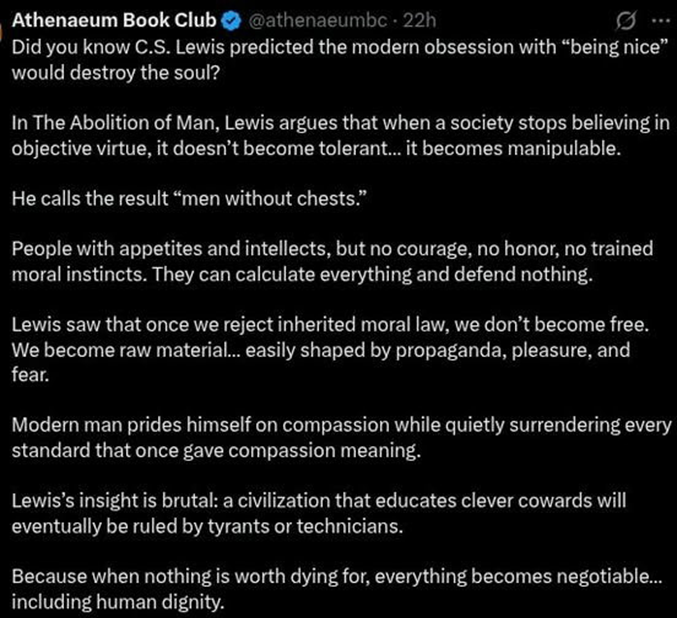
It is no surprise that sloth is a characteristic of MCS driven by NPD. Empathy takes effort. Scapegoating and sacrificing victims to one’s narcissism is easy.
Recognizing and accepting the boundaries of others takes restraint. Crossing lines is doesn’t.
Looking for meaning outside one’s self, the internet, and media takes effort. Accepting one’s self-narration of experiences, like a pre-written movie, is easy.
“The sixth Deadly Sin is named by the Church Acedia or Sloth. In the world it calls itself Tolerance; but in hell it is called Despair. It is the accomplice of the other sins and their worst punishment. It is the sin which believes in nothing, cares for nothing, seeks to know nothing, interferes with nothing, enjoys nothing, loves nothing, hates nothing, finds purpose in nothing, lives for nothing, and only remains alive because there is nothing it would die for. We have known it far too well for many years. The only thing perhaps that we have not known about it is that it is mortal sin.” ― Dorothy L. Sayers, The Other Six Deadly Sins
For Sayers, this is the evil enchantment of the modern age.
~~~
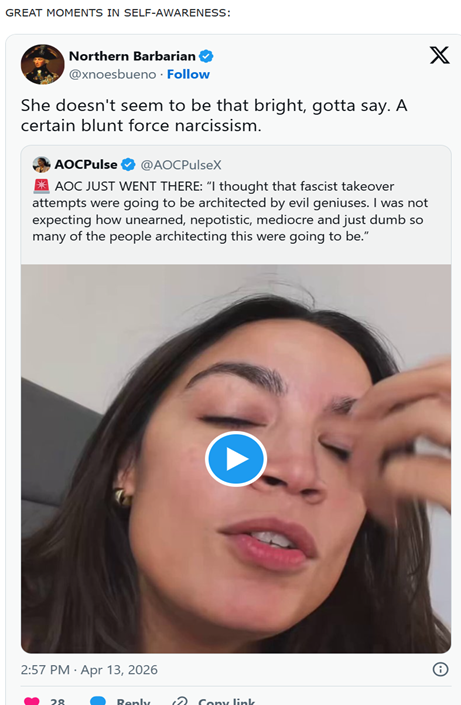
Men without chests: