“You will own nothing and you will be happy.”
This published World Economic Forum slogan, derived from a reposted blog essay by a Danish politician titled “Welcome to 2030. I own nothing, have no privacy, and life has never been better,” embodies a vision of doing away with the ownership of private property and autonomy in favor of a shared and planned economy overseen by the “providence” of WEF elites.
The proposed systems or platforms would provide technological access to needed resources, thereby providing gratification – so says the Dane. What is not said: in order to produce a hyper-egalitarian world, such comprehensive oversight of humans would require the beating down, leveling, debasing, and tyrannizing of the humans into thinking and accepting what is doled out in terms of what is valued per the elites.
“Have we discovered some new reason why, this time, power should not corrupt as it has done before?” – C.S. Lewis, from the third essay in The Abolition of Man.
The overlords of the modern bureaucratic state (presumptuously) use rational control to solve all problems with (smug) amoral certainty. Rational control? R.J. Snell writing for Acton Institute regarding Harvey C. Mansfield’s recent book The Rise and Fall of Rational Control: The History of Modern Political Philosophy:
According to Mansfield, modernity is intrinsically linked to Machiavelli. . .
Rational control depended on ending irrational control, meaning custom, which includes social mores, institutions, and “God or the gods.” Rational control requires our liberation from the divine; humanity itself serves as a principle of order, asserting “human rights as against divine rights.” Moral custom can survive the taming of the gods, however, so morality must also be placed on a rational basis. For Machiavelli, princes must learn “how to be not good.” Ancient philosophers constructed utopian principles, but moderns take guidance from the “effectual truth” of action. The ruthless doing of “the necessary” establishes and preserves the city.
Who is Niccolo Machiavelli (1469 -1527)? See below.
The WEF’s Brave New World kind of slogan, with its enchantment of fulfillment via a Soma-like numbing- homogenizing process that divests the individual of all worldly (and otherworldly) concerns, I read as “rational control” ending “irrational control.” The ownership of inherited values and identity from the older cosmic order that included the transcendent Overworld is to be exchanged for the management of affairs by the realpolitik of “princes.” Their new modes and orders will displace what came before, replace the “ought” with the “is,” and effect the ruthless doing of “the necessary” via devices with avatars, apps and AI.
(Our world has many glory seeking manipulative “princes.” They rule their principalities in the WEF, the EU, and the UN. They rule in city, state, and federal government. They are the tech bros pushing AI and data centers down our throats.)
“You will own nothing and you will be happy “represents the presumed gratifying effects of rational control giving materialism and science unquestioned authority over our lives to produce “effectual truth” outcomes. Subjects of the slogan are to sell their souls to the “princes” of this world to make way for “man’s freedom … to answer his own needs with his own arms.”
Those enchanted by a managed existence absent of meaning and free will, such as the Danish politician, are apparently OK with a world that is increasingly disconnected from “the past, people, place, and prayer” and increasingly connected to “science, self, sex, and screens” (Paul Kingsnorth, Against the Machine).
Chuck Chalberg, writing for the Imaginative Conservative:
Kingsnorth might not have needed to define each of his S’s, but he does: Science gives us a “non-mythic” story of our origins; “the highest good is to serve the self”; sex is an “affirmation of individual identity”; and the screen is “both our main source of distraction from reality and the interface by which we are directed into the coming post-human reality of the machine.”
I view such world as cold and indifferent, in a calculating, utilitarian, mechanistic, ad-addled, app-addled, drug-addled, increasingly violent, and wretched way.
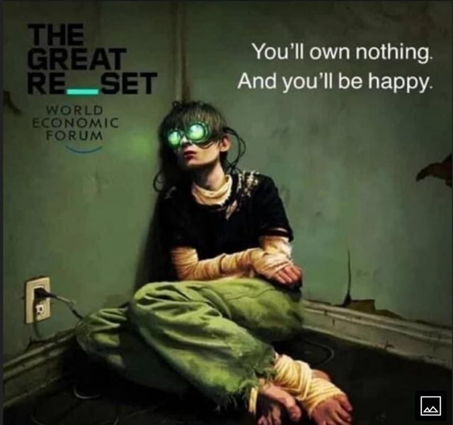
Those enchanted by a dystopian existence are apparently OK with living in a pathological environment, one that has “almost no qualities of a sane, wise, productive, creative environment that we would wish for ourselves” (Iain McGilchrist).
“You will own nothing and you will be happy” is scientific reductionism’s disenchantment of the world.
Henri Bortoft writes at The Nature Institute about the 18th to 19th century German polymath Johann Wolfgang von Goethe’s way of perceiving:
Goethe [sought a method that, in his words] “did not treat of nature as divided and in pieces, but presented her as working and alive, striving out of the whole into the parts.” The first thing we notice here is the reversal of perception: not from the part to the whole, but from the whole into the parts. Goethe was someone who could see the wholeness in nature directly, and, furthermore, had specific practices that could lead to the ability to do so.
C. S. Lewis, in English Literature in the Sixteenth Century (1954), wrote that no longer is the universe thought of as an orchestra “tingling with anthropomorphic life, dancing, ceremonial, a festival.” Now it is thought of in terms of a machine. In terms of language, Lewis’ understood that
“Pre-modern metaphors were animated; the cosmos seemed saturated with presence, soul, and being. In contrast, modern man prefers inorganic metaphors borrowed from the steady, unwavering movement of machines.” (Jason Baxter, “Evil Enchantment” versus Platonic Vision: Dante, Lewis, and the Weight of Glory) (The After Dinner Scholar podcast).
Many have witnessed and written about the ongoing deconstruction of our inherited perception of the cosmos.
Below, two poets, a professor of Medieval and Renaissance Literature, a modern playwright and a psychiatrist/neuroscientist account the withdrawing from the ages-old animating symphonic signal (objective values of truth, beauty, and goodness) toward modern machine noise (amoral realpolitik’s ruthless doing of “the necessary”):
“Its melancholy, long, withdrawing roar”
In 1867, Matthew Arnold wrote a poem about the decline of religious belief in mid-nineteenth-century Britain. Dover Beach speaks of a sea change during the Victorian era: the rising tide of scientific discovery and the withdrawing “sea of faith.” He saw Christian faith increasingly challenged by the influences of materialism and scientific discoveries.
Dover Beach portrays the effect with words describing loss and alienation from what had been so encompassing:
The Sea of Faith
Was once, too, at the full, and round earth’s shore
Lay like the folds of a bright girdle furled.
But now I only hear
Its melancholy, long, withdrawing roar,
Retreating, to the breath
Of the night-wind, down the vast edges drear
And naked shingles of the world.
“A heap of broken images”
T. S. Eliot’s 1922 poem The Waste Land, written in the wake of WWI, describes the barrenness and alienation of modern life. With a collage of cultural allusions, Eliot portrays modern society as shallow, the rich spiritual and cultural landscape of the past reduced to rubble. Society, he writes, is dealing with “A heap of broken images.”
What are the roots that clutch, what branches grow
Out of this stony rubbish? Son of man,
You cannot say, or guess, for you know only
A heap of broken images, where the sun beats,
And the dead tree gives no shelter, the cricket no relief,
And the dry stone no sound of water.
“a bad spell, an evil enchantment”
Jason M. Baxter, in his essay “Evil Enchantment” versus Platonic Vision: Dante, Lewis, and the Weight of Glory,” writes of professor C.S. Lewis’ take on the negation of goodness referencing a compilation of Lewis’ sermons tiled Transposition (1944) and his book The Abolition of Man (1943):
“The oxford don consistently used the metaphor of a bad spell, arguing that modernity had cast an “evil enchantment of worldliness” that makes the weight of goodness fell less substantial. In fact, Lewis argued that there was a kind of historical chasm or gaping cultural canyon that separated modernity from anything that came before: what he called the “Great Divide.” . . . This is, in part, because our image of the cosmos and our understanding of its operations are radically different from that of the pre-modern world. Our metaphors have changed: “The fundamental concept of modern science is, or was until very recently, that of natural ‘laws.’. . . In medieval science the fundamental concept was that of certain sympathies, antipathies, and strivings inherent in matter itself.” Modern man speaks about how a falling rock obeys a law of nature; medieval man spoke of the rock as desiring or longing to return to its natural place, like a pigeon returning to its nest by a homing instinct. Pre-modern metaphors were animated; the cosmos seemed saturated with presence, soul, and being. In contrast, modern man prefers inorganic metaphors borrowed from the steady, unwavering movement of machines. (My emphasis.)
. . .
“When the animate picture of the cosmos and the organic metaphors used to describe it passed away, two other changes followed. The first is that we began to imagine the sources of deep meaning were located within, not without. As Charles Taylor has put it, we “conceive of ourselves as having inner depths. We might even say that the depths which were previously located in the cosmos, the enchanted world, are now more readily placed within.” Lewis wrote about this displacement of meaning in his impassioned critique of modern education, The Abolition of Man.”
(You can read Baxter’s complete essay w/footnotes in my post “Self-Central Casting.” The article is brought to you for free and open access by Digital Commons @ George Fox University)
The Abolition of Man was published in 1943. Three lectures by C.S. Lewis form the book: Men Without Chests, The Way, and The Abolition of Man.
In identifying the pathologies of the age, Lewis warned about the consequences of doing away with ideas of objective value and natural law. Moral relativism, he claimed, would-result in the Abolition of Man and Men Without Chests. He defended the existence of a moral consensus among mankind that transcends cultures, polities, and historical epochs.
Lewis sought to reenchant the world with his fiction: The Space trilogy, Till We have Faces, The Chronicles of Narnia and other works.
In a 1946 essay “Talking about Bicycles” Lewis wrote about how understanding changes in terms of “four ages about nearly everything.” He gave them names: the unenchanted age, the enchanted age, the disenchanted age, and the reenchanted age.
We are in a disenchanted age.
Where do values come from?
British playwright and screenwriter Tom Stoppard (1937-2025) was known for plays that are both comedic and philosophical.
This is true of one of his most famous plays, the 1966 absurdist tragicomedy Rosencrantz and Guildenstern Are Dead. Two minor characters from Shakespeare’s Hamlet become main figures in a play ‘outside’ the narrative of Shakespeare’s Hamlet (which has a play within a play).
From the play’s synopsis at Stage Agent:
Part Shakespearean tragedy, part Laurel and Hardy comedy routine, part Waiting for Godot absurdity, Tom Stoppard’s masterful debut play calls fate, free will, art, reality, communication, and the very constructs of theatre into question, all the while leading two most honorable, adventurous, brilliant, and inept characters on their path to their unfortunate, unavoidable, infamous fate.
His 1972 play Jumpers “intertwines high-minded discussion with broad comic absurdity.” Stoppard “explores and satirizes the field of academic philosophy by likening it to a less-than-skillful competitive gymnastics display.” It is set in a university “where philosophy has become a battleground rather than a search for truth.” It is a bewildering world of pragmatists and relativists where logic has confounded belief in moral absolutes. The play raises questions of “What do we know?” and “Where do values come from?”
Stoppard’s 2015 play The Hard Problem again deals the ultimate source of objective goodness and value.
Lauren Halvorsen, at Studio Theater:
In constructing Hilary, Stoppard explains, “I wanted to write a character who is good—not goody-goody—and believes that goodness has an objective reality which is not captured by, explained by, or defined by evolutionary science, by evolutionary psychology, by evolutionary biology, by neo-Darwinism.” Hilary’s faith is ridiculed by her colleagues—but they can’t fully refute her stances. Stoppard investigates the interplay of faith and fact, irrationality with would-be rational behavior. How would neuroscientists definitively prove that every instinct is chemical, explicable, and geared for survival? And what happens to our beliefs when science can’t hold all the answers? Can some ideas only be understood through an unquantifiable intuition?
…
In a world driven by empirical data, Hilary is a controversial figure—she argues passionately in favor of free will, defends altruism as more than self-interest, and believes in God, much to the consternation of her materialist fellow scientist and occasional lover Spike. And it gradually emerges that Hilary’s stances are informed, in part, by personal reasons: at age 15, she had a baby and made an adoption plan, and now prays for her daughter as she wonders what became of her.
We are living in a pathological environment
Iain McGilchrist – psychiatrist, philosopher and neuroscientist:
“There is no question. We are living in a pathological environment. It has almost no qualities of a sane, wise, productive, creative environment that we would wish for ourselves. It has very few of those qualities that characteristically lead to those qualities. It maximizes conflict. It incubates extreme points of view. It robs us of embodied and embedded wisdom that comes from the culture and proximity to the natural world.
All these things that used to be taken for granted are now robbed of us and it’s no surprise that responses are massive existential anxiety, depression, suicidal thinking, a sense of hopelessness, complete loss of meaning. . . it is a complete tragedy because it doesn’t have to be like that. We need to break out of the prison we have made for ourselves.”
The above excerpt from the May 2026 video & podcast – Civilization’s Imbalance and Restoring the Humanities: The Divided Brain
https://www.unsiloedpodcast.com/episodes/iain-mcgilchrist
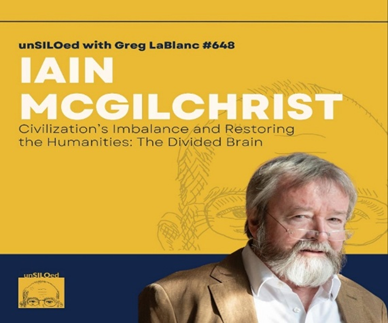
Iain McGilchrist discusses how the brain works; how left and right hemispheres attend to things – thereby making a difference on how we respond to the world.
Ultimate Meaning with objective standards for goodness and value is being explained away by neuroscience reductionist claims that meaning comes down to brain chemistry and atoms. If there is meaning, it is described in terms of an inexorable evolutionary process at work to pass on our genes in the best way possible. (See Is God the answer to our Meaning Crisis? Video below.)
Are we to view life through scientific reductionism’s microscope?
Are we to be viewed life through scientific reductionism’s microscope?
Should we be logical positivists and base all knowledge on perceptual experience and consider metaphysical and subjective arguments not based on observable data as meaningless?
Should we live accepting that there is nothing but matter and disregard intuition or revelation for “the science?”
Is life to be understood using only the science text book of humans (which scientism perverts for “effectual truth” outcomes) and not the gestalt of human consciousness as found in poetry (that provides meaning)?
Admittedly, there is a lot to ponder here.
As I have written before, I am an autodidact. I have no degree. I read and study that which interests and concerns me. Then, I put it down in words. The above is not some term paper to be graded. The above is what I have come to understand: what I was looking for since my earliest days, since The Day the Music Died.
It wasn’t until I reached my 70s that I understood the loss of connection to true mythos and the orchestra “tingling with anthropomorphic life, dancing, ceremonial, a festival.”
~~~
Who is Niccolo Machiavelli (1469 -1527)?
Here’s a brief Yale lecture (video, podcast & transcript) about the Florentine, the founder of the modern state, and his book, “The Prince”: Lecture 10 – New Modes and Orders: Machiavelli, The Prince (chaps. 1-12)
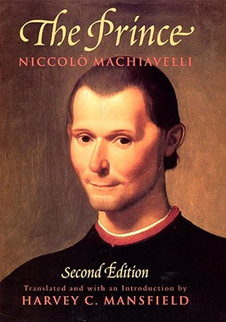
“Machiavelli announces his break, indeed his repudiation of all those who have come before, all those who have come before. He both replaces and yet reconfigures according to his own lights, elements from both the Christian empire and the Roman republic, to create a new form of political organization distinctly his own.” (This description of Machiavelli could be describing today’s Progressive politicians and many church organizations!)
(This being Memorial Day weekend, I doubt that the “princes” of this world will honor the fallen. They’ll be busy barbecuing and planning their next doing of “the necessary.”
~~~
The modern state increasingly treats culture not as an independent civilizational inheritance deserving protection but as raw material to be supervised, corrected, and ideologically aligned. The old pastoral ideal of the fulfilled and self-reliant individual citizen gradually gives way to the therapeutic subject: managed, supervised, controlled, yet perpetually assured of her freedom in “our democracy.”
A civilization survives only when there remain spheres of life politics cannot wholly absorb. Once politics becomes everything, civilization itself begins to disappear.
The Politicization Of Everything | ZeroHedge
Authored by David Solway via The Epoch Times,
Don’t become a Green grocer.
~~~
Elizabeth Oldfield & James Marriott: Is God the answer to our Meaning Crisis? | Uncommon Ground
Elizabeth Oldfield, host of the Sacred Podcast, and James Marriott, literary critic and Times columnist, join Justin on Uncommon Ground to discuss whether we can find meaning in life without God.
Elizabeth tells of her own search for meaning in Christian faith, while James explains why, as an atheist nihilist, he still loves art and literature. They discuss the search for purpose, and signs of a new interest in faith among young people.
Elizabeth Oldfield & James Marriott: Is God the answer to our Meaning Crisis? | Uncommon Ground
For Elizabeth Oldfield: https://www.elizabetholdfield.com/
For James Marriott: https://www.thetimes.com/comment/columnists/article/full-fat-faith-the-young-christian-converts-filling-our-churches-x69pd289k?
~~~


@kingdomventurers.com
I think you've hit the nail on the head. It's good to know there are still some rational people out there that can see the futility in a society solely centered on unilateral, unequivocated utility. We forget that we were, and still are, creatures made solely of flesh. What we consider our "humanity" is a fruit of the spirit created by millenia of love, pain, and sacrifice. To create a world without those is to create a world without Humanity.
Remote Reply
Original Comment URL
Your Profile
Why do I need to enter my profile?
This site is part of the ⁂ open social web, a network of interconnected social platforms (like Mastodon, Pixelfed, Friendica, and others). Unlike centralized social media, your account lives on a platform of your choice, and you can interact with people across different platforms.
By entering your profile, we can send you to your account where you can complete this action.